Home » Solutions » Energy Storage » Battery Energy Storage Systems (BESS)
Battery Energy Storage Systems (BESS) allow commercial and institutional facilities to store electricity for use during peak demand, grid outages, or time-of-use rate windows. These systems improve resiliency and reduce energy costs, while enabling participation in demand response and utility incentive programs.
Battery storage helps commercial facilities take control of energy use, reduce costs, and prepare for power disruptions. Get a custom design tailored to your site and utility program.
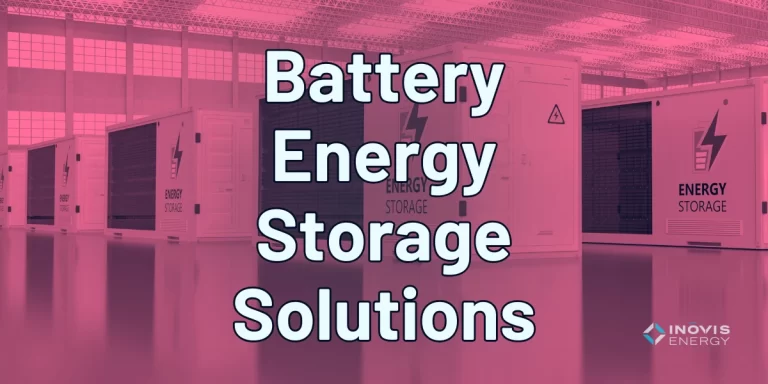
Battery Energy Storage Systems (BESS) are scalable, on-site battery banks that store electricity for strategic use. Charged by the grid, solar panels, or other on-site generation, BESS units discharge energy when it’s most valuable—during peak pricing periods, outages, or when solar production drops.
Commercial BESS applications include:
Peak shaving to lower demand charges
Load shifting to avoid high time-of-use electricity rates
Resiliency and backup power for critical loads
Solar-plus-storage systems to maximize on-site generation
Participation in grid services and demand response programs
Most commercial BESS installations use lithium-ion batteries due to their efficiency and compact footprint, though other technologies like flow batteries may be viable for long-duration storage.

Key Benefits:
Reduce peak demand charges and lower utility bills
Maintain operations during grid outages
Increase ROI of solar PV systems by storing excess generation
Participate in utility programs like ConnectedSolutions or SGIP
Enhance energy independence and power quality
Improve ESG performance through energy resilience and load flexibility
Integrate with Building Automation or Energy Management Systems
A typical BESS includes:
Battery modules (often lithium-ion) that store DC energy
Inverter/charger units to convert electricity between AC and DC
Energy management software to control charge/discharge schedules
Safety systems and controls to monitor voltage, temperature, and faults
The system charges when electricity rates are low (off-peak), solar is overproducing, grid demand is low
It discharges when utility rates spike (on-peak or demand events), solar production is insufficient, the grid fails and backup power is needed
BESS systems can be grid-tied, solar-paired, or integrated into a microgrid for full facility resilience.
While BESS doesn’t create energy, it helps facilities use energy more intelligently. This results in cost and efficiency gains by:
Reducing peak demand charges, which can represent up to 50% of commercial utility bills
Shifting loads to off-peak hours using stored energy
Maximizing solar self-consumption, avoiding export to the grid at low value
Avoiding outages or brownouts, which can be costly for critical facilities
Enabling participation in grid programs that offer financial incentives for load flexibility
Facilities with high energy loads, peak demand charges, or backup power needs—such as schools, medical centers, data centers, municipalities, manufacturing, and solar-equipped buildings.
Site & Load Analysis – Review historical utility data, solar output (if applicable), and critical load profiles
System Sizing – Design the optimal battery capacity, inverter size, and control logic
Incentive and Interconnection Review – Apply for relevant state/federal rebates and utility approval
Procurement and Install – Install batteries, inverters, software, and safety systems
Commissioning and Integration – Test system, connect to EMS/BMS or solar, and train staff
Ongoing Monitoring – Enable remote management, fault alerts, and performance tracking
Battery storage is eligible for a combination of powerful incentives and flexible financing:
Federal Investment Tax Credit (ITC) – 30% or more
ConnectedSolutions (MA, RI, CT) or SGIP (CA) utility incentives
Performance-based payments for demand response or VPPs
On-bill repayment or energy-as-a-service models with no upfront capital
Projects are often cash-flow positive, especially when paired with solar or peak-load-intensive operations.
Battery storage helps commercial facilities take control of energy use, reduce costs, and prepare for power disruptions. Get a custom design tailored to your site and utility program.